





CBA Home Loans: Application Documents, Approval and Refinancing Guide

Applying for a home loan or refinancing through Commonwealth Bank of Australia (CommBank, often abbreviated CBA) requires more than choosing a headline interest rate. Income records, existing liabilities, identity verification, the property’s characteristics and lending assessment can all affect the outcome. This guide focuses on the application, documentation, conditional approval and refinancing steps. For rates, fee structures and loan-feature comparisons, see our separate CommBank rates and features guide. Cen Xianyuan is not a mortgage broker or affiliated with the bank.
Before you apply: understand conditional preapproval
CommBank describes a conditional preapproval and application process. A conditional assessment is not an unconditional promise of finance. The lender may still examine your credit position, serviceability, property, valuation and documents before making a formal offer. Avoid making irreversible commitments based only on a preliminary amount.
Documents CommBank says applicants may need
| Document type | Examples | Why the lender asks |
|---|---|---|
| Identity | Accepted Australian ID or other listed identity documents | Verify applicants’ identities |
| Employment and income | Payslips, bank statements, employment letter or tax returns | Assess sustainable repayment capacity |
| Debts and expenses | Loan statements, credit-card limits and living costs | Check existing commitments |
| Property and sale | Contract of sale and conveyancer details where applicable | Understand proposed security and purchase |
| Savings and assets | Deposit and other source-of-funds evidence | Confirm contribution and borrowing structure |
| Self-employment | Relevant business financials and tax material | Assess income where wage evidence is insufficient |
The bank’s official application checklist lists examples of these records. Specific requirements depend on your employment arrangement, existing customer status, property, loan purpose and current policy. Gather sensitive documents only through a confirmed secure bank channel.

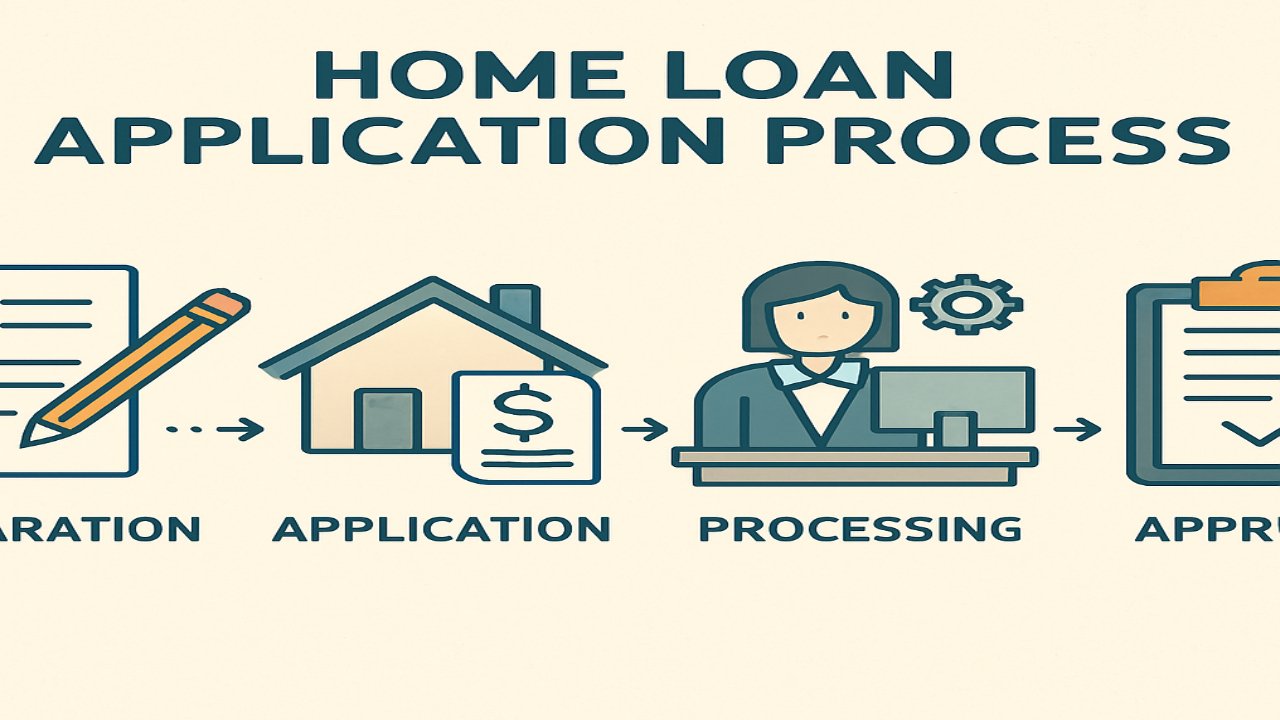
A seven-step application workflow
- Estimate a sustainable repayment budget, allowing for insurance, utilities, housing maintenance and emergencies.
- Choose the loan type and check whether a fixed, variable or split arrangement suits your needs.
- Confirm eligibility and which identification/income documents are required.
- Obtain a lender assessment or preapproval and understand what remains conditional.
- Find a property and review the contract with a qualified solicitor or conveyancer.
- Submit the formal documents and respond to any valuation or underwriting questions.
- Review the written offer, repayment schedule, fees and loan conditions before acceptance and settlement.
Applying online versus speaking to a lending specialist
CommBank publishes an application-in-app guide and describes options for speaking to specialists. Available digital features and eligibility depend on the product and applicant. If your income is irregular, you are self-employed, borrowing jointly or purchasing a nonstandard property, ask which application route is suitable rather than assuming the shortest online flow can handle it.
What changes for a first-home buyer?
Buyers should compare deposit requirements, stamp duty or transfer duty by Australian state, mortgage insurance where relevant, and any current first-home-buyer concessions. Eligibility varies with residence, intended use, property value, income and other criteria. Do not rely on a generic article to establish that you qualify for a government program; check the relevant official authority.
Refinancing: evaluate costs before switching
Refinancing moves a home loan to different terms or another lender. CommBank’s refinancing guide outlines reviewing the existing mortgage, comparing options, submitting documents and settlement. ASIC Moneysmart warns that break costs, discharge fees, application costs and lenders mortgage insurance can outweigh a lower rate. There is no universal saving from refinancing.
Simple break-even example
Imagine refinancing would reduce total monthly costs by A$90 but trigger A$1,800 in one-off charges. Ignoring time value, loan balance changes and any tax considerations, the nominal break-even is A$1,800 ÷ A$90 = 20 months. If you expect to move or refinance again in 12 months, those figures would not support claiming an immediate saving. The figures are hypothetical and not current CommBank offers.
Five refinancing questions
- Will ending my existing fixed loan incur a break charge?
- What will happen to my loan term—will it reset to 30 years?
- How much will the total finance charge change over the years I expect to hold the loan?
- Does a new loan require valuation, mortgage insurance, legal or settlement fees?
- Will I lose important offset, redraw, repayment or insurance arrangements?
If the bank requests additional documents
A request for more evidence does not mean approval is guaranteed or that the application has been rejected. It may reflect verification, security or credit-assessment requirements. Provide documents only through official channels, track pending items and ask for a written explanation of anything you do not understand. Never share a one-time password with someone claiming to fast-track approval.
Common borrower mistakes
- Confusing a promotional comparison rate with the rate you qualify for.
- Omitting a credit commitment or inaccurately reporting household expenses.
- Assuming conditional preapproval is the same as unconditional approval.
- Comparing monthly repayments for different loan terms without checking total interest.
- Ignoring early-repayment charges and account/package fees.
- Submitting personal financial documents through a lookalike website or unsolicited email.
Frequently asked questions
How long does approval take?
There is no guaranteed timeline. Document checks, underwriting, valuation and settlement logistics can change the process. Ask the lender for a current estimate for your circumstances.
Can a self-employed borrower apply?
Potentially, but the bank may request business tax returns, financial statements or other records. Review its latest published requirements.
Does refinancing always reduce repayment costs?
No. Fees, remaining term, rate changes, mortgage insurance and features may offset or exceed savings.
Should I share payslips or ID with an online intermediary?
Only after confirming the intermediary’s identity, authority and secure process. Use the lender’s official app or approved portal whenever possible.
How to calculate loan-to-value ratio (LVR)
LVR compares the mortgage amount with the lender’s accepted property value. The formula is (loan amount ÷ property value) × 100. A lower LVR generally means the lender is taking less security risk, although the rate offered still depends on product rules and borrower assessment.
Suppose a home costs A$750,000, the lender’s valuation is also A$750,000 and you contribute A$150,000 toward the purchase price. Borrowing A$600,000 produces an LVR of 80%. If the lender instead values the same property at A$720,000, that A$600,000 loan represents approximately 83.3% of the lender’s valuation. The difference can affect pricing, mortgage-insurance rules or the lender’s willingness to approve the deal. Purchase costs such as transfer duty and legal fees also require funding, so a 20% deposit does not necessarily cover all cash needed.
LVR and upfront cash: worked scenarios
| Illustrative case | Purchase price | Deposit toward price | Loan amount | LVR assuming price = bank valuation |
|---|---|---|---|---|
| A: 20% down | A$750,000 | A$150,000 | A$600,000 | 80% |
| B: 10% down | A$750,000 | A$75,000 | A$675,000 | 90% |
| C: 5% down | A$750,000 | A$37,500 | A$712,500 | 95% |
These are mathematical scenarios, not CommBank approval rules, an offer of a 95% LVR loan or an estimate of the total cash to close. Transfer duty, conveyancing, inspections, property valuation, eligible government concessions and any lenders mortgage insurance can change your real upfront cost. Check official state revenue websites for location-specific rules.
How banks assess serviceability and living expenses
Serviceability is about the ability to make required loan repayments while paying other commitments and living costs. A lender can assess income stability, credit cards (including unused limits), car loans, personal loans, dependants, regular household spending and existing housing expenses. A high gross salary does not automatically mean the same amount is safely available for mortgage payments.
Australian lenders apply lending policies and prudential standards when testing repayment capacity. APRA’s residential mortgage lending guidance discusses appropriate underwriting and risk controls. Your lender may test whether you could manage a materially higher interest rate than the initial offered rate; that does not mean your actual contract will charge that stress-test rate.
A household budget test before you apply
Imagine two applicants bring home A$9,000 a month. Their normal spending includes A$3,800 for essentials, A$950 for transport and existing commitments and A$500 for irregular expenses. That leaves A$3,750 before a new mortgage, but treating the entire A$3,750 as a safe housing payment would leave no emergency buffer. They should also budget for property rates, home insurance, repairs, strata charges if any, moving costs and the possibility of income interruption. These amounts are illustrative and do not predict lender-assessed borrowing capacity.
- Calculate a typical month using actual bank statements, not an optimistic spending guess.
- Include annual bills divided into monthly amounts, such as insurance renewals and car registration.
- Account for costs likely to change after buying, such as utilities, commuting and maintenance.
- Recalculate repayments at higher rates, and keep funds for emergencies instead of using every dollar as a deposit.
- Do not conceal debts or overstate income to improve an application.
Full document checklist for different applicant types
Salaried employees
Prepare the current employer information, suitable recent payslips, income summaries if requested, identification, and evidence of regular salary deposits. If probation, overtime, allowances or bonuses are relevant, ask how the lender treats that income, because it may be assessed differently from fixed ordinary earnings.
Self-employed borrowers
Depending on the application and the bank’s current documentation rules, you may be asked for tax returns, assessment notices, business financial statements, accountant details and evidence of business income. Explain large differences between recent tax years. A business turnover figure is not the same as personal assessable income.
Joint borrowers and existing homeowners
Joint applicants may both need to provide identity, income and liability records. If a borrower already owns property, the lender may seek current mortgage statements, rental income evidence, rates and other property obligations. Ask how negative gearing, expenses or nonstandard income are assessed rather than assuming every dollar of rent counts.
Conditional approval, valuation and settlement explained
| Stage | What usually happens | What it does NOT mean |
|---|---|---|
| Initial enquiry | Discuss loan purpose, budget and product options | No binding finance commitment |
| Conditional preapproval | Early assessment of applicants and certain documents | Not guaranteed unconditional funding |
| Property review | Contract, property characteristics and lender valuation examined | Purchase price is not necessarily the accepted value |
| Unconditional approval | Credit and security conditions may be satisfied, subject to contract | Not a reason to ignore settlement obligations |
| Settlement | Solicitor/conveyancer and financial parties complete transfer and funding | Not a guarantee of future rates or refinancing terms |
Ask your conveyancer about contract deadlines and how finance clauses apply in your state. The timing and conditions of a mortgage contract should be read with professional assistance if the consequences of an unsuccessful settlement would be material.
First-home-buyer costs and schemes
First-home-buyer support can include federal or state schemes, but it does not automatically apply to every applicant. Qualification can depend on citizenship or residency, household circumstances, previous ownership, location, property value, occupancy and the program’s current rules. Contact the program administrator or lender for the actual conditions before making an offer based on a possible concession.
Also budget for building and pest inspections where appropriate, conveyancing, moving, electricity and internet setup, home and contents insurance and council or strata expenses. A mortgage calculator usually does not estimate all these items. CommBank’s calculator collection includes an upfront-cost estimator, repayment tools and refinancing calculator.
Repayment examples: the effect of interest rates
For a hypothetical A$600,000 fully amortizing, principal-and-interest home loan over 30 years, with a constant rate and monthly payments, the following amounts are approximate. They exclude fees and all other homeownership costs. These are not actual CommBank rates.
| Assumed annual interest | Approximate monthly principal + interest | Change versus 5% |
|---|---|---|
| 5.0% | A$3,221 | — |
| 6.0% | A$3,597 | +A$376 |
| 7.0% | A$3,992 | +A$771 |
| 8.0% | A$4,403 | +A$1,182 |
An increase in rates changes the required repayment under many variable loan arrangements, and a fixed loan can face a different rate at the end of its fixed term. Calculate multiple scenarios and ask the bank how long your proposed rate applies. ASIC Moneysmart recommends examining affordability under higher interest rates rather than only today’s repayment estimate.
Offset accounts: a calculation and an important safeguard
An eligible 100% offset account can reduce the balance on which mortgage interest is calculated. For example, if a A$600,000 loan is fully linked to a A$40,000 offset balance, daily interest may be based on A$560,000 rather than A$600,000 while that balance remains in the account. At a hypothetical 6.0% annual rate, the rough simple-interest saving for keeping A$40,000 in an effective offset for a full year would be around A$2,400 before fees, changing balances and loan-term effects. This is a simplified illustration, not a guaranteed statement or individualized projection.
Compare any extra annual package fee or higher loan rate against the likely offset saving. Moneysmart also warns that an offset account needs to be linked correctly to the loan. Check your loan statements and request an explanation of the interest calculation if the connection or savings are unclear.
Offset account versus redraw
- Offset: money generally stays in a linked transaction account and can reduce interest; check whether the offset is full or partial.
- Redraw: extra repayments reduce your outstanding loan balance and may be accessible later, subject to terms, limits and lender administration.
- Fees: some offset-eligible loan packages can cost more than simpler alternatives.
- Cash access: an offset account and redraw are not identical in terms of ownership, access conditions or treatment in different circumstances.
- Fixed-rate loans: extra repayments, offset and redraw can be restricted, so check your particular product.
What to do if a home loan application is declined
An unsuccessful application does not automatically mean you can never borrow. Ask what general eligibility or credit-assessment factor prevented the application, while recognizing that lenders might not disclose all internal scoring details. Check for inaccurate credit-report information, excessive debt commitments, documentation gaps or affordability concerns and seek an appropriate qualified adviser when needed.
- Do not immediately submit numerous similar applications without understanding the initial issue.
- Review credit files for incorrect records and dispute genuine errors through the provider’s process.
- Consider whether a smaller purchase budget or larger savings buffer would create a sustainable repayment level.
- Resolve documentation mismatches and make sure declared income and expenses are accurate.
- Be cautious with advertisements promising guaranteed approval or asking for upfront charges for a special deal.
Refinancing checklist: calculate net savings, not just a lower rate
Refinancing can create savings but may incur break costs, application charges, valuation and discharge fees, new insurance charges or different ongoing account costs. A lower repayment caused by restarting a 30-year term may increase total lifetime interest. ASIC’s switching-home-loans guidance recommends weighing savings against fees and the cost over the expected holding period.
For example, suppose a switch costs A$2,400 upfront and saves A$120 a month when comparing total ongoing costs on equivalent terms. A simple nominal break-even is 20 months. But if the new mortgage requires an extra A$250 annual package fee that was not in the monthly estimate, your net savings fall. This example shows why asking for written total costs matters; it is not a recommendation to refinance.
When to get independent advice
A qualified mortgage broker or licensed financial or legal professional can be useful when income is complex, multiple properties are involved, your loan is approaching a fixed-rate expiry, a contract contains unfamiliar obligations or hardship makes regular repayments uncertain. Ask what fees or lender commissions apply and whether the adviser compares a broad enough range of lenders. You can also obtain general consumer information from ASIC Moneysmart; it does not endorse individual mortgage products.
A short mortgage glossary for Australian borrowers
- Principal: the actual amount owed to the lender, excluding future interest.
- LVR: the mortgage balance divided by the lender’s accepted property value.
- Comparison rate: a standardized rate designed to include the advertised rate and certain fees under stated assumptions.
- LMI: lenders mortgage insurance, which protects the lender against certain default losses rather than protecting the borrower.
- Fixed term: the agreed period for an unchanged contractual interest rate, not necessarily the entire loan term.
- Revert rate: the rate applied after certain introductory or fixed-rate periods, according to contract.
- Settlement: the legal and financial process that completes the property transaction.
- Offset: an eligible linked account used to reduce the loan balance on which interest is calculated.
- Redraw: access to previously made extra principal repayments, subject to conditions.
Final borrower checklist
Before signing, keep a complete copy of the written quote, Key Facts Sheet if available for that product, expected repayment schedule, APR/comparison rate assumptions, all fees, fixed-term and revert-rate clauses, offset and redraw conditions, contract documents and identity of the lender. Make decisions using current written terms rather than a blog’s rate claim or a bank’s marketing headline.
Sources and editorial note
Reference: CommBank application documentation, home loan process, refinancing guide and ASIC Moneysmart switching costs. This is general informational content, not a loan quote, financial advice, credit assessment or proof of approval.





1 Comment
[…] account of applying for a mortgage. For step-by-step application documentation, read our separate CBA home loan application and refinancing guide. Please confirm all financial details with a licensed adviser or the bank where […]