




Car Insurance Deductibles Explained: Collision, Comprehensive and Examples

A car insurance deductible is the amount you ordinarily pay toward a covered claim before the insurer pays its portion. But the word “deductible” is often misunderstood: it does not apply identically to liability, collision, comprehensive, personal injury protection and every other type of auto coverage. The practical answer depends on the coverage listed on the declarations page and how the particular loss is treated. This guide explains deductibles with transparent examples, trade-offs, claims checklists and questions to ask an insurer. It is U.S.-focused general information, not a substitute for an insurance contract or licensed advice.
Practical details, verified references and useful decisions: What does a car insurance deductible actually do · Collision and comprehensive: understand the difference · Worked example: a claim with a 500 deductible. Read official sources for changing rules and prices.

What does a car insurance deductible actually do?
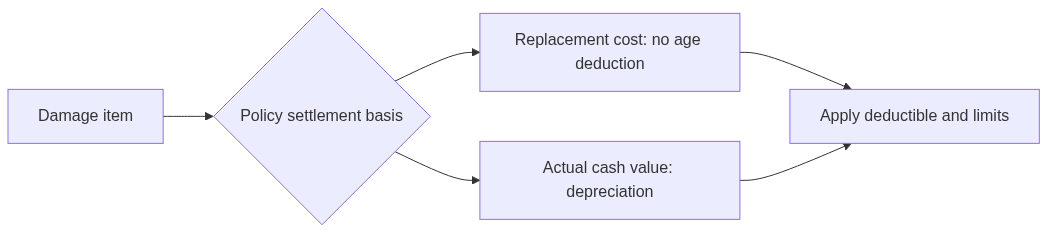
When damage is eligible under a part of your policy that carries a deductible, the insurer typically assesses the covered amount, subtracts the deductible, then applies any relevant coverage limits or exclusions. A deductible is not an annual subscription fee or a universal percentage of every loss; it can be an amount chosen for one coverage type or a different amount for another.
| Coverage type | Usual deductible treatment | Example situation |
|---|---|---|
| Collision | Frequently has its own deductible | Your car is damaged in a collision with another vehicle or object |
| Comprehensive | Usually a separate deductible | Eligible theft, hail, falling debris or certain non-collision damage |
| Liability | Generally no deductible on ordinary personal auto liability coverage | Covered damage or injury you cause to someone else |
| Uninsured motorist / PIP | Depends heavily on state and policy provisions | Covered injury or damage where special state coverage rules apply |
These are common patterns, not rules guaranteed for every state or contract. Refer to the NAIC auto insurance consumer guidance and your state insurance department to understand the protection available locally.
Collision and comprehensive: understand the difference
Collision commonly responds to covered physical damage from a vehicle collision, including certain impacts with objects. Comprehensive commonly responds to covered causes outside ordinary collisions, such as theft or specified weather events. Exact treatment of animals, glass, weather and exclusions can vary. You may select a different deductible for each portion of the same car policy; inspect both figures before filing a claim.
Worked example: a claim with a $500 deductible
Assume a fully covered loss is assessed at $3,000, there is no separate limit preventing payment and the applicable deductible is $500. In the simplified example, the policyholder is responsible for $500 and the insurer’s payment is $2,500. If the repair estimate instead totaled $400, that is below the same $500 deductible, so the insurer would generally pay $0 under that coverage. Whether the real-world claim is covered and how a repair settlement is issued must be determined by the actual policy.

How a higher deductible can affect premiums
Choosing a larger deductible often reduces premiums, because the insurer assumes less of the initial claim cost. But savings are not always proportional to the extra risk. Suppose Quote A is $120 monthly with a $500 collision deductible and Quote B is $112 monthly with a $1,000 deductible. B saves $8 per month, or $96 per year, but creates an extra $500 out-of-pocket exposure on an otherwise identical covered collision. This is a completely invented example—not an insurer quote or actuarial forecast. Evaluate whether your emergency savings can absorb the larger amount.
Comparing deductible options fairly
| Question | Why it matters |
|---|---|
| Which specific coverage carries the deductible? | Collision and comprehensive can differ |
| Does glass damage have a special option? | Some contracts and states allow different treatment |
| Is there a deductible waiver? | Eligibility and conditions must be established |
| Will the repair amount exceed the deductible? | A very small claim may pay little or nothing |
| Are there separate limits, depreciation or exclusions? | The estimate alone does not determine payment |
| How much is the actual premium saving? | Compare dated written quotes for identical coverage |
What happens if another driver causes the crash?
There may be different avenues for pursuing compensation depending on fault, state law, the other driver’s insurance and your decision to use your own collision coverage. If you claim through your own collision policy, your deductible may initially apply; the insurer may later seek reimbursement from a responsible third party (subrogation), but any refund is not guaranteed. Do not assume that police or insurer fault assessments automatically eliminate the deductible. Ask the claims representative how your state and policy handle it.
Should you submit a small claim?
A small claim may not result in a meaningful payout after the deductible. However, deciding whether to report an incident can involve notification duties and safety considerations beyond the repair amount. If another person was injured, another car or property was damaged, or the accident involves a possible dispute, comply with applicable legal and policy reporting requirements. Ask the insurer how a claim might affect renewal and underwriting; never conceal reportable incidents to preserve an assumed discount.
Claim documentation checklist
- Move to safety and contact emergency services when necessary.
- Record the date, location and circumstances without making speculative admissions.
- Photograph vehicle damage where safe and legal.
- Gather relevant policy details, driver and witness information.
- Check the declarations page for deductible and coverage type.
- Ask the insurer who arranges inspections, estimates and repairs.
- Keep receipts, claim references and written explanations of exclusions.
- Ask for clarification if settlement figures differ from the repair estimate.
Common mistakes
- Assuming a deductible applies to every type of claim.
- Confusing a premium payment with a deductible paid at claim time.
- Believing a higher deductible always makes financial sense.
- Failing to check separate collision and comprehensive amounts.
- Assuming an at-fault driver’s insurer will automatically refund your deductible.
- Using an old blog’s premium sample as a live personalized insurance quote.
Frequently asked questions
Is a $1,000 deductible automatically better than $500?
No. A lower premium comes with higher potential out-of-pocket costs. Assess the real quote difference and your emergency savings.
Do I pay the deductible directly to the insurance company?
Not always. It may be taken out of a claim settlement or paid to the repair facility. Ask how your specific claim will be handled.
Is a deductible the same as a coverage limit?
No. The deductible reduces an otherwise eligible payment; a coverage limit caps what the policy may pay.
What if the repair is cheaper than the deductible?
The insurer may pay nothing for that covered portion, although other reporting or liability obligations can still matter.
Does liability auto insurance have a deductible?
Ordinary personal auto liability coverage typically does not, but read your actual policy and any special endorsements.
Sources and editorial disclosure
Based on the National Association of Insurance Commissioners auto coverage resources and NAIC consumer material. For general policy comparison, see our AAA vs State Farm comparison. The two original diagrams are illustrative and the financial examples are fictional. Cen Xianyuan is not an insurer, has not adjusted a claim for readers and does not guarantee coverage, premiums or settlement outcomes.
Information is provided for general guidance. Verify current rules, availability and individual terms with the official organizations linked in this guide.