



30 Best Horror Movies of All Time: Greatest Scary Films
30 Best Horror Movies of All Time
Great horror movies do more than make an audience jump. The strongest films stay unsettling long after the credits, create images that become part of popular culture, and influence generations of filmmakers who follow them.
This guide to the 30 Best Horror Movies of All Time brings together psychological horror, supernatural stories, slashers, science-fiction horror, zombie films, folk horror and some of the most important early movies in the genre.
No ranking of horror films can be completely objective. This list gives extra weight to lasting influence, critical reputation, originality, atmosphere and how well each movie continues to work for audiences years or even decades after its release.


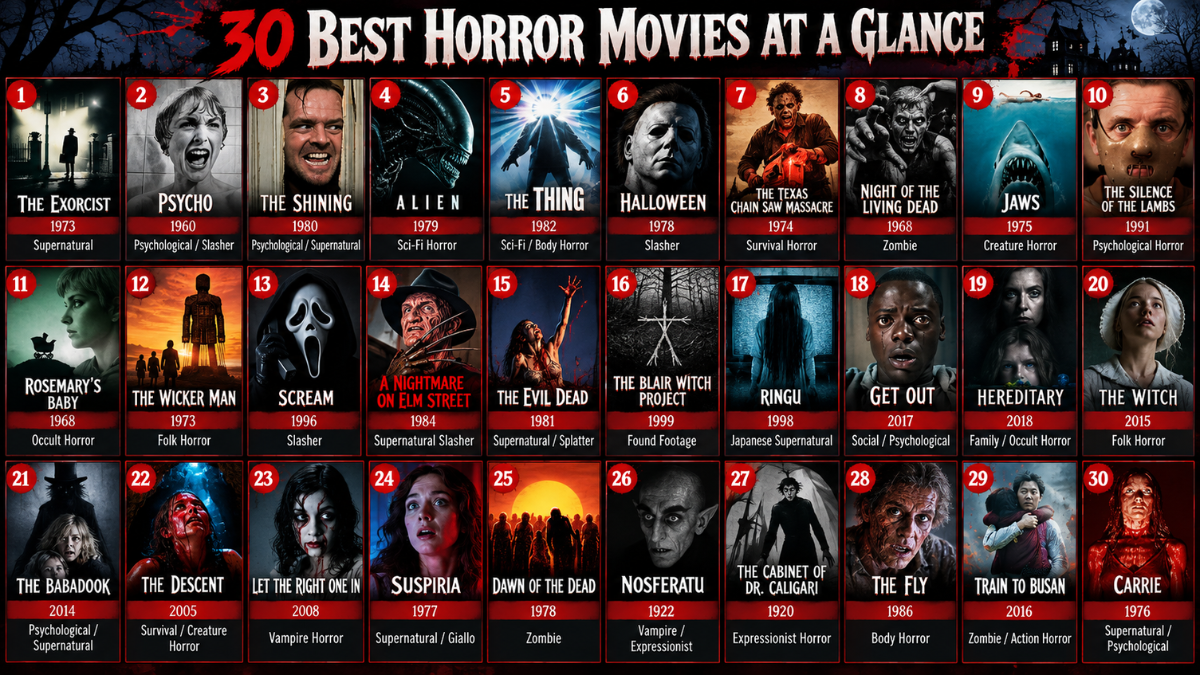
30 Best Horror Movies At A Glance
| # | Movie | Year | Style |
|---|---|---|---|
| 1 | The Exorcist | 1973 | Supernatural |
| 2 | Psycho | 1960 | Psychological / Slasher |
| 3 | The Shining | 1980 | Psychological / Supernatural |
| 4 | Alien | 1979 | Sci-Fi Horror |
| 5 | The Thing | 1982 | Sci-Fi / Body Horror |
| 6 | Halloween | 1978 | Slasher |
| 7 | The Texas Chain Saw Massacre | 1974 | Survival Horror |
| 8 | Night of the Living Dead | 1968 | Zombie |
| 9 | Jaws | 1975 | Creature Horror |
| 10 | The Silence of the Lambs | 1991 | Psychological Horror |
| 11 | Rosemary’s Baby | 1968 | Occult Horror |
| 12 | The Wicker Man | 1973 | Folk Horror |
| 13 | Scream | 1996 | Slasher |
| 14 | A Nightmare on Elm Street | 1984 | Supernatural Slasher |
| 15 | The Evil Dead | 1981 | Supernatural / Splatter |
| 16 | The Blair Witch Project | 1999 | Found Footage |
| 17 | Ringu | 1998 | Japanese Supernatural |
| 18 | Get Out | 2017 | Social / Psychological |
| 19 | Hereditary | 2018 | Family / Occult Horror |
| 20 | The Witch | 2015 | Folk Horror |
| 21 | The Babadook | 2014 | Psychological / Supernatural |
| 22 | The Descent | 2005 | Survival / Creature Horror |
| 23 | Let the Right One In | 2008 | Vampire Horror |
| 24 | Suspiria | 1977 | Supernatural / Giallo |
| 25 | Dawn of the Dead | 1978 | Zombie |
| 26 | Nosferatu | 1922 | Vampire / Expressionist |
| 27 | The Cabinet of Dr. Caligari | 1920 | Expressionist Horror |
| 28 | The Fly | 1986 | Body Horror |
| 29 | Train to Busan | 2016 | Zombie / Action Horror |
| 30 | Carrie | 1976 | Supernatural / Psychological |
1. The Exorcist (1973)
William Friedkin’s The Exorcist remains one of the defining supernatural horror films. What makes it effective is not simply its most shocking scenes, but the seriousness with which it treats the increasingly terrifying situation inside one ordinary home.
The film gradually turns a family crisis into a confrontation involving faith, medicine, fear and the possibility of something genuinely supernatural.
Its influence can still be seen in possession films decades later, yet very few have matched its atmosphere of dread.
2. Psycho (1960)
Alfred Hitchcock changed horror cinema with Psycho.
The Bates Motel, Bernard Herrmann’s score and one of the most famous shower sequences in film history became cultural landmarks, but the movie remains effective because Hitchcock constantly manipulates what the audience thinks the story is about.
Its influence reaches far beyond horror into thrillers, slashers and psychological crime films.
3. The Shining (1980)
Stanley Kubrick transforms an isolated mountain hotel into one of horror cinema’s most unsettling environments.
The Shining uses long corridors, strange geometry, repeated visual patterns and an increasingly unstable central performance to create a feeling that something is wrong even during apparently quiet scenes.
Its images—from the elevator to the twins in the hallway—have become inseparable from modern horror culture.
4. Alien (1979)
Ridley Scott’s Alien combines science fiction with the structure of a haunted-house movie.
The Nostromo becomes a dark maze, while H.R. Giger’s creature design gives the film a monster unlike anything mainstream audiences had seen before.
Much of the tension comes from waiting—listening to machinery, watching empty corridors and knowing that something may be hiding just outside the frame.
5. The Thing (1982)
John Carpenter’s The Thing turns isolation and mistrust into horror.
A group trapped at an Antarctic research station cannot be certain who is still human, creating paranoia even before the film reveals its famously grotesque creature effects.
The combination of practical effects, bleak atmosphere and distrust has helped the movie grow from a divisive original release into one of the genre’s most respected classics.
6. Halloween (1978)
John Carpenter’s Halloween demonstrated how much fear could be created with simple ingredients: suburban streets, a masked figure, careful framing and an unforgettable minimalist score.
Michael Myers frequently appears quietly in backgrounds and doorways rather than immediately attacking, allowing anticipation to do much of the work.
The film helped establish the template followed by countless slashers.
7. The Texas Chain Saw Massacre (1974)
Tobe Hooper’s film feels rough, hot and almost documentary-like.
Despite its title and reputation, much of the horror comes from atmosphere rather than constant graphic violence.
The remote house, disturbing family and relentless final stretch create an exhausting survival experience that has rarely been duplicated.
8. Night of the Living Dead (1968)
George A. Romero transformed the zombie movie with Night of the Living Dead.
A small group barricades itself inside a farmhouse while reanimated corpses gather outside. The simple setup becomes increasingly claustrophobic as arguments inside the house become nearly as dangerous as the creatures outside.
Modern zombie cinema and television owe an enormous debt to this film.

9. Jaws (1975)
Steven Spielberg proves that horror does not need ghosts or demons.
Jaws builds fear around the ocean itself, often withholding a clear view of the shark and allowing John Williams’ music to signal danger before anything appears.
The movie is equally strong as a character drama and adventure film, which helps explain why it remains so watchable decades later.
10. The Silence of the Lambs (1991)
The Silence of the Lambs sits on the border between horror, crime thriller and psychological drama.
Its most famous scenes rely on conversation rather than violence. Hannibal Lecter’s calm intelligence makes him frightening precisely because he rarely needs to raise his voice.
The film became one of the rare horror-adjacent productions to dominate the major Academy Award categories.
11. Rosemary’s Baby (1968)
This slow-burning occult horror film turns an apartment building, neighbors and even marriage into sources of uncertainty.
The audience shares Rosemary’s growing suspicion that something is being hidden from her, but the film continually makes her—and the viewer—question whether those fears are justified.
12. The Wicker Man (1973)
The Wicker Man is one of the essential folk-horror movies.
A police officer travels to an isolated island while investigating a missing girl and slowly realizes that the community operates according to beliefs radically different from his own.
The beautiful rural setting makes the growing unease more effective rather than less.
13. Scream (1996)
Wes Craven revitalized the slasher genre by making characters aware of the rules of horror movies.
Scream can be funny and self-aware while still delivering suspenseful stalking sequences and a memorable masked killer.
Its influence was immediate, shaping the tone of late-1990s horror and countless later meta-horror films.
14. A Nightmare on Elm Street (1984)
Freddy Krueger works because he removes the one place where people normally expect to be safe: sleep.
Wes Craven uses dream logic to blur what is real and what is imagined, giving the movie far more visual freedom than an ordinary slasher.
15. The Evil Dead (1981)
Sam Raimi’s low-budget breakthrough throws a group of young people into an isolated cabin where supernatural forces quickly take control.
The aggressive camera movement, practical effects and escalating madness make The Evil Dead feel wildly energetic even decades later.
BFI describes it as the quintessential cabin-in-the-woods horror movie and a cult classic whose influence expanded through sequels, television, games and comics.
16. The Blair Witch Project (1999)
Few horror films changed marketing and presentation as dramatically as The Blair Witch Project.
The handheld footage, improvised performances and intentionally limited information made audiences feel as though they were watching material that had genuinely been discovered after something terrible happened.
Its influence helped turn found footage into a major horror format.
17. Ringu (1998)
Hideo Nakata’s Japanese horror landmark builds its story around a cursed videotape.
The central idea is simple, but the movie’s restrained atmosphere, unsettling imagery and famous final sequence helped create an international wave of interest in Japanese horror.
18. Get Out (2017)
Jordan Peele combines psychological horror, social satire and suspense in a story that becomes increasingly disturbing as seemingly minor interactions begin to reveal a larger pattern.
Get Out arrived with an unusually distinct voice and quickly became one of the defining horror films of the 2010s.
19. Hereditary (2018)
Ari Aster’s feature debut begins as a family drama shaped by grief before slowly revealing something much darker.
Hereditary is especially effective because its supernatural horror grows out of believable family tension rather than replacing it.
Toni Collette’s performance gives the movie an emotional intensity that makes later events even more disturbing.
20. The Witch (2015)
Robert Eggers places a Puritan family at the edge of a forest in 17th-century New England.
The isolation, historically influenced dialogue and religious anxiety create a world where fear, guilt and supernatural possibility become difficult to separate.
It is a slow-burning film, but that patience is central to its power.
21. The Babadook (2014)
Jennifer Kent uses a frightening children’s book and mysterious creature to explore grief, exhaustion and the strain between a mother and son.
The film’s emotional foundation makes the supernatural material far more effective than a simple monster story.
22. The Descent (2005)
A group of women enters an underground cave system and discovers that claustrophobia is only the beginning of their problems.
Even before its creatures fully emerge, The Descent creates powerful fear from darkness, narrow spaces and the possibility of becoming trapped far below the surface.
23. Let the Right One In (2008)
This Swedish vampire story is quiet, cold and unexpectedly emotional.
Rather than presenting vampirism only as spectacle, the movie builds a strange relationship between two lonely young characters and lets the horror emerge naturally around them.
24. Suspiria (1977)
Dario Argento uses color, architecture and music almost as aggressively as other directors use monsters.
Suspiria follows an American student who joins a German dance academy hiding a supernatural secret.
Its visual style is so distinctive that individual frames can feel like nightmare paintings.
25. Dawn of the Dead (1978)
George A. Romero expanded the world of his earlier zombie film by moving survivors into a shopping mall.
The larger scale allowed him to combine gore, action and social commentary about consumer behavior.
The mall setting became one of the most memorable locations in zombie cinema.
26. Nosferatu (1922)
More than a century after its release, F.W. Murnau’s Nosferatu still contains some of horror cinema’s most recognizable images.
Count Orlok is skeletal and unnatural rather than romantic, and the movie’s shadows, architecture and silent-film techniques give it the quality of a nightmare preserved on film.
BFI describes it as cinema’s first vampire feature and highlights its expressionist visual techniques and lasting influence.

27. The Cabinet of Dr. Caligari (1920)
Robert Wiene’s silent German film looks unlike almost anything made before or since.
Painted shadows, distorted streets and deliberately unnatural sets turn the entire movie into a visual representation of instability.
Its influence on horror, film noir and expressionist production design is enormous.

28. The Fly (1986)
David Cronenberg turns a science-fiction experiment into one of cinema’s great body-horror stories.
Jeff Goldblum’s scientist initially believes his invention has improved him, but the transformation becomes progressively more disturbing.
The practical makeup effects are memorable, but the tragedy underneath them is what gives the movie lasting weight.
29. Train to Busan (2016)
South Korea’s Train to Busan places a rapidly spreading zombie outbreak inside and around a moving passenger train.
The confined setting creates excellent action, but the film also works because viewers care about the passengers and their relationships.
It is one of the strongest examples of a modern zombie movie finding new energy in a familiar genre.
30. Carrie (1976)
Brian De Palma’s adaptation of Stephen King’s novel mixes teenage cruelty, family abuse and supernatural power.
The famous prom sequence is only one reason the film remains memorable. Much of its power comes from the audience understanding Carrie’s vulnerability before everything collapses into horror.
Best Horror Movies By Type
| If You Like… | Start With |
|---|---|
| Supernatural horror | The Exorcist, Hereditary, The Babadook |
| Psychological horror | Psycho, The Shining, The Silence of the Lambs |
| Slashers | Halloween, Scream, A Nightmare on Elm Street |
| Zombie movies | Night of the Living Dead, Dawn of the Dead, Train to Busan |
| Science-fiction horror | Alien, The Thing, The Fly |
| Folk horror | The Wicker Man, The Witch |
| Classic horror | Nosferatu, The Cabinet of Dr. Caligari |
Best Horror Movies For Beginners
If you are only beginning to explore horror, you do not necessarily need to start with the most disturbing films.
Jaws is an excellent entry point because it works as adventure and suspense as well as horror. Scream is accessible because it combines humor with scares, while Alien works equally well for science-fiction fans.
For modern horror, Get Out offers an easy introduction to a movie that is entertaining on the surface while containing much more beneath it.
Which Horror Movie Is The Scariest?
There is no objective answer because people are frightened by very different things.
Someone who fears supernatural possession may find The Exorcist unbearable. A claustrophobic viewer may struggle more with The Descent. Someone disturbed by isolation and distrust may find The Thing or The Shining more effective.
The best horror often connects with a fear the viewer already has.
Frequently Asked Questions
What is one of the greatest horror movies ever made?
The Exorcist, Psycho, The Shining and Alien are among the films most consistently treated as major horror landmarks, although the answer depends on the type of horror you prefer.
What is the best classic horror movie?
For silent-era horror, Nosferatu and The Cabinet of Dr. Caligari are essential. For later classics, Psycho and Night of the Living Dead are excellent starting points.
What is the best zombie movie?
Night of the Living Dead is historically essential, Dawn of the Dead greatly expands Romero’s zombie world, and Train to Busan is one of the strongest modern examples.
What is the best slasher movie?
Halloween is one of the genre’s most influential examples, while Scream later reinvented slasher conventions through self-aware characters and humor.
What is a good modern horror movie?
Get Out, Hereditary, The Witch and The Babadook are all strong modern choices with very different approaches to horror.
Is The Silence of the Lambs really horror?
It is frequently classified as psychological thriller, crime and horror simultaneously. Its imagery, serial-killer subject matter and sustained fear make it a natural inclusion in many horror discussions.
Final Thoughts
The best horror movies survive because they frighten audiences in different ways.
The Exorcist confronts supernatural evil. Psycho makes an ordinary roadside motel terrifying. Alien turns deep space into a haunted house. The Thing makes every human face suspicious, while Night of the Living Dead helped create the modern zombie movie.
More recent films such as Get Out, Hereditary and The Witch show that horror continues to change without abandoning the fears that made the genre powerful in the first place.
If you are exploring these movies for the first time, do not worry too much about watching them in ranking order. Pick the style of horror that sounds most interesting and work outward from there.
Research & Further Reading
Rotten Tomatoes — Best Horror Movies of All Time
Time Out — 100 Best Horror Movies
BFI — A Great Horror Film From Every Year
Editorial note: “Best” is subjective. This list emphasizes long-term reputation and influence rather than simply reproducing the ranking of any single critic or website.