




Replacement Cost vs Actual Cash Value in Home Insurance: Examples and Checklist
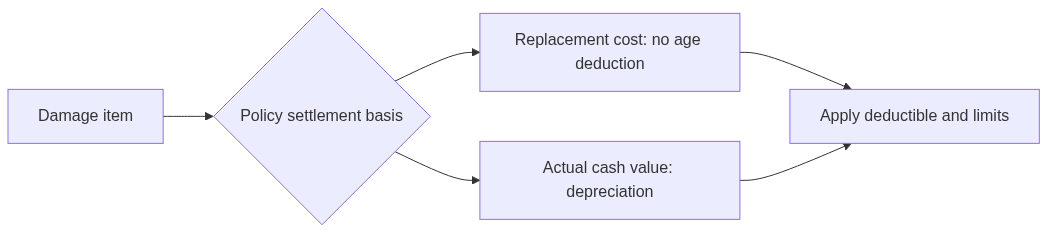
Homeowners insurance uses several different values, and choosing the wrong one can leave a household badly underinsured after a serious loss. A property’s real-estate market price is not the same as the cost to rebuild the structure. Actual cash value (ACV) coverage considers depreciation, while replacement cost value (RCV) generally does not subtract depreciation for an eligible repair or replacement using comparable materials. These distinctions are particularly important for older roofs, personal belongings and a total-loss rebuild. This practical U.S.-focused guide gives worked examples and a checklist for reviewing an actual policy, without claiming a particular insurer will pay any example amount.
Practical details, verified references and useful decisions: Three values that must not be confused · Worked example: 10000 covered damage · Why the roof needs special attention. Read official sources for changing rules and prices.
Three values that must not be confused
| Value | What it means | Why it differs |
|---|---|---|
| Market value | Estimated amount a home and land could sell for | Includes location, land and housing demand |
| Replacement cost | Amount to rebuild or replace covered property using like kind and quality | Depends on labor, materials, construction and local codes |
| Actual cash value | Covered replacement/repair cost adjusted for depreciation | Condition, age and wear can reduce settlement |
The NAIC’s consumer explanation distinguishes replacement cost from actual cash value and explicitly notes that market value includes land. A home selling for $450,000 could conceivably require a different amount to rebuild because the land value and costs of construction are different. Do not insure solely on the property’s purchase price.
Worked example: $10,000 covered damage
Assume a covered repair costs $10,000 and the deductible is $1,000. With an eligible replacement-cost settlement and no separate exclusion or sublimit, the example’s net amount would be $9,000. For ACV, suppose depreciation is assessed at $3,000; the simplified covered amount becomes $7,000 before the $1,000 deductible, producing $6,000. The $3,000 depreciation is fictional, not a standard formula or typical insurer reduction. Actual settlement involves policy terms, claim-adjustment methods and deductible handling.
Why the roof needs special attention
Roof claims may have endorsements that differ from the rest of the house. Some policies apply actual cash value to roofs, particularly as they age; others offer replacement coverage subject to eligibility, conditions and percentage deductibles for wind or hail. A statement that a home has “replacement cost insurance” does not always mean every roof loss receives a full new roof. The NAIC roof settlement guide explains why the distinction matters.
What is a percentage deductible?
Some catastrophe coverage uses a deductible calculated as a percentage of the dwelling coverage amount rather than a fixed number. For example, a 2% deductible applied to a $300,000 insured dwelling limit equals $6,000. That does not mean 2% of the repair bill. This example is arithmetic only: the exact trigger, calculation, covered event and percentage vary. Ask whether wind, hail, hurricane or named-storm deductibles apply to your area and which events activate them.

Dwelling insurance and the rebuilding estimate
Dwelling Coverage A is commonly a central part of a homeowners policy. A reasonable reconstruction estimate should consider rebuilding materials, labor rates, home size, unusual features, code upgrades, debris removal and contractor availability after major disasters. An old insurer estimate may not reflect renovations or regional cost increases. Ask how the insurer calculates a replacement-cost estimate and what options exist when a severe regional disaster raises costs.
Personal property: contents and limits
Furniture, electronics, clothing and tools often have different coverage options from the building. ACV can provide less than the amount needed to purchase a modern equivalent; replacement cost endorsements may offer broader reimbursement but sometimes require receipts or replacement within a specified period. Jewelry, collectibles, art and specialized electronics can have their own sublimits or scheduling requirements. Document expensive items and ask whether special coverage is appropriate.
Claim settlement is not always one payment
Some replacement-cost policies initially issue a payment based on an ACV calculation, with recoverable depreciation payable after covered repairs or replacements are documented according to policy conditions. Ask what receipts or invoices are required, what deadlines apply, and whether the insurer has approved the repair scope. Do not commit to expensive work before checking whether the loss is actually covered or whether additional approvals are required.
Home inventory checklist
- Walk room by room and photograph valuable or difficult-to-replace belongings.
- Record purchase dates, serial numbers and realistic replacement values when available.
- Keep receipts and ownership documents in a secure location separate from the house.
- Review the insurer’s limits for jewelry, antiques, business equipment and electronics.
- Update inventory after major purchases or renovations.
- Protect personal data when saving cloud backups or sending documents.
The NAIC homeowners resources explain why a home inventory helps with insurance preparation.
Eight questions to ask before renewal
- Is my dwelling insured for a professional reconstruction estimate or just the market price?
- Is the settlement basis ACV or RCV for the dwelling, roof and contents separately?
- Is there a percentage deductible for storms?
- What are the limits for extra living expenses after a covered loss?
- Are flood and earthquake excluded, requiring separate protection?
- Is any ordinance-or-law coverage provided for changed building codes?
- Does an extension or guaranteed replacement-cost endorsement exist, and what are its conditions?
- How do I document repairs to recover withheld depreciation?
Flood, earthquake and other exclusions
A standard homeowners contract commonly excludes flood damage; separate flood insurance may be necessary. Earthquake insurance can also be separate or require an endorsement. Water damage from a sudden internal pipe failure is not automatically treated the same as rising floodwater, long-term seepage or sewer backup. Read the cause-of-loss wording rather than relying on a generic claim that “water damage is covered.” If you live in an exposed area, consult the official state department of insurance or a qualified agent.
How to compare quotes without misleading savings claims
Get quotes for the same dwelling reconstruction estimate, deductible, settlement type, personal property limits and endorsements. A cheaper ACV quote should not be compared with a more comprehensive replacement-cost quote as though only the price changed. Verify annual premium, payment fees, deductible and what happens after a claim. An offer of “full replacement value” is not meaningful without a legal description of the coverage.
Common mistakes
- Using the property’s sale price to choose dwelling limits.
- Assuming all replacement policies cover roof depreciation in the same way.
- Ignoring high percentage storm deductibles.
- Failing to document household items before a disaster.
- Confusing a maximum limit with guaranteed payment.
- Claiming flood or earthquake coverage without checking exclusions.
- Failing to check the time limit for replacement-cost documentation.
Frequently asked questions
Is replacement cost always equal to market value?
No. Market value is affected by the land and real estate market, while replacement cost concerns rebuilding or replacing eligible insured property.
Does RCV mean the insurer buys me a newer, better house?
No. Payments remain subject to like-kind-and-quality provisions, deductibles, limits, exclusions and settlement rules.
Can two homeowners have different deductibles for the same storm?
Yes. The chosen policies, dwelling limits, endorsements and state rules can differ.
Should I make a claim for every small repair?
Not necessarily. Compare the loss to the deductible and consider policy notification obligations. Contact the insurer about material incidents.
Primary references and editorial transparency
Read the NAIC ACV versus replacement-cost explainer, NAIC shopping checklist and NAIC roof loss guide. For related background, see our home insurance guide. Infographics are original simplified educational diagrams. All settlement amounts here are hypothetical; they are not a quote, claims determination or professional insurance advice.
Information is provided for general guidance. Verify current rules, availability and individual terms with the official organizations linked in this guide.